







An affordable and challenging training method. Many athletes always have one in their bag. A skipping rope – the secret that’s long since ceased to be a secret. Ideal for fitness training, burning calories, as a warm-up, or even for a full-body workout. Nowadays, more and more athletes are turning to a skipping rope. You can set specific training goals to improve your footwork, endurance, speed, explosiveness or coordination. The ideal training companion at any time of day. By constantly increasing the speed, you can very easily improve your fitness with a skipping rope. The high intensity ensures rapid calorie burning or acts as a great complement to your strength training. You can create a full-body workout by alternating the skipping rope with other exercises. For example, combine it with a fitness ball to work on your core, or with dumbbells to strengthen your upper body.
Skipping ropes for adults too!
In boxing, skipping is a time-honoured training method for improving speed, stamina and footwork. And in the world of cross-training, you can’t do without a speed rope – also known as a cross-training skipping rope – for a few double unders. Why is the skipping rope so popular? It’s because it allows you to train the two most important aspects: The body and the mind. Firstly, cardio – the benefits for cardio are enormous. With skipping exercises, you can increase your heart rate two to three times faster than with most other exercises. The workout is similar to running, but with far less impact on your joints. Secondly, mental sharpness. By incorporating different patterns and rhythms whilst jumping, skipping engages both the left and right hemispheres of your brain. Your brain stores these movements, allowing you to improve your coordination quickly. A speed rope is a skipping rope for advanced users. It allows for greater speed, improves footwork and coordination. Take a look at our skipping ropes page to see which one suits you best.
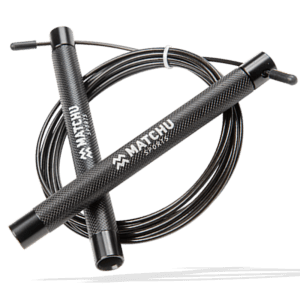
Skipping rope exercises
Let’s start with an overview of all the exercises. This will help you easily find the exercises that appeal to you most. You could, for example, choose five exercises and do one every minute, alternating with 60 seconds’ rest. This will give you a good ten-minute workout. After a while, you can build this up by adding more exercises and doing them for longer.
Single unders, also known as a basic jump, form the basis of skipping. They are quite simple to do; you simply need to jump to a normal height whilst letting the rope pass under your feet once.
Double unders
Double unders are undoubtedly the most popular jumping technique in CrossTraining. Put simply, double unders are the same as single unders, except that you let the rope pass under your feet twice before your feet touch the ground again. This means it’s important to make a good, powerful jump. Click here for a detailed step-by-step guide on how to perform a double under.
Power jumping
With a power jump, you don’t use a rope; you use only your body. Power jumps are all about how much power you put into your jumps.
That’s why they form the basis for tricky jumps such as double unders.
It’s important not only to practise jumping with more power, but also to absorb the impact of your landing correctly.
So practise this by doing a series of powerful jumps in quick succession.
Double hop
A double hop is when you jump twice before letting the rope pass under your feet. Do this by taking two quick jumps on your toes. Practise this, for example, by doing it a few times without the rope first.


It’s important that you keep doing this in time with the rhythm of your strokes.
Skip kick
With a skip kick, you do pretty much the same as with a skip jump, except you kick forwards with a different leg each time. Make sure you do everything in sync and in time with the beats of your skipping rope.
Little kicks
Little kicks are pretty much the same as skip kicks, except you kick less high and faster. It’s important to keep alternating legs and to kick forward in quick succession. Kick every time you let the rope pass under your feet.
Stomp kicks
For stomp kicks, first push off the ground with both feet, then deliver a small kick with each foot in turn. Switch feet after every kick. Make sure you keep to the correct sequence: push off once with both feet – a kick forwards, and so on.
With high knees, the name pretty much says it all – you lift your knees up. You bring your knees up to your waist one at a time. Make sure you keep in time with the rhythm and don’t change your speed.


In the side-to-side movement, you make small jumps from left to right. It’s important to keep your feet close together. You keep alternating the foot you put the most weight on as you push off for each jump. Your jumps should also remain low so that you can do it at speed.
Slalom
In the slalom, you take a big jump from left to right. Whilst keeping both feet together, you keep jumping about a metre from left to right. You must ensure that you push off the ground with both feet at the same time each time.
With the front-to-back jump, you’re essentially doing exactly the same as in the slalom, except that you’re jumping from front to back rather than from left to right. You do this by taking a jump of about one metre from front to back each time. Make sure your feet are side by side and that you push off the ground with both feet at the same time.


In the criss-cross, you cross your legs over each other whilst jumping. As you jump, you keep moving one leg from left to right. It’s important to keep doing this at a steady pace.

Get started yourself!
As you can see above, there are loads of variations in skipping. Some are harder to do than others. But with regular practice, any form of skipping should be possible. Also, before you start your skipping workout, you should carefully consider which muscles you want to train and make sure you’re swinging the rope from your wrists.
When putting together a skipping workout, it’s important to first assess how long you can skip for in one go. If 60 seconds is still too long, start with 30-second rounds.
Skipping can also help you train for other sports. Think of interval running or boxing to improve your coordination. It’s simply a really fun and varied workout! And thanks to its compact size, a skipping rope is very easy to pop into your sports bag.
It’s also important to keep track of how many calories you burn per workout. Would you like to know more about this? Then have a look at our article on how many calories you can burn by skipping. It’s also very important that your skipping rope is the right length. Would you like to know more about this? Then read our article on ‘How long should my skipping rope be?’. And if you really want to know everything there is to know about skipping, have a look at our ultimate guide to skipping.